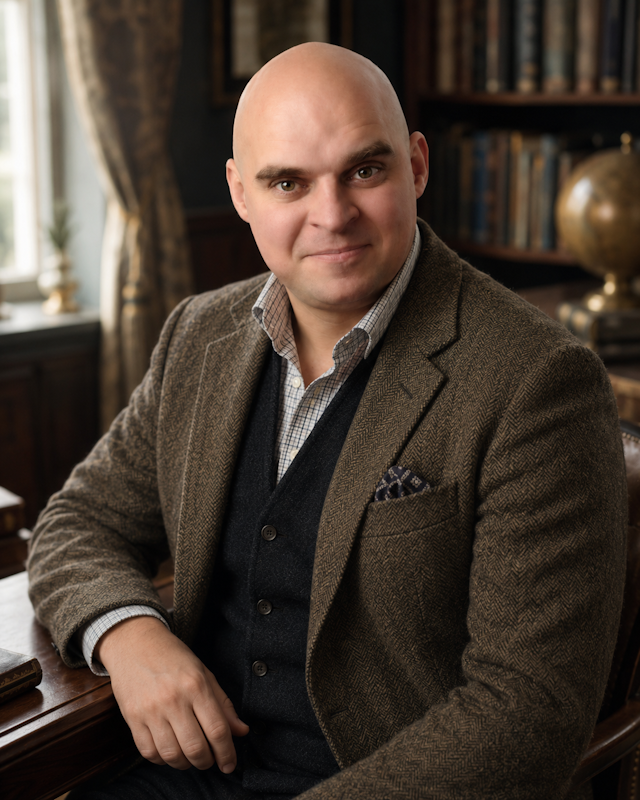
From curiosity to books
Evgeny Leonov did not arrive at writing through a literature department or according to a carefully prepared master plan. Much of his adult life was tied to entrepreneurship, independent projects and practical work. It left him with a habit of taking ideas apart like mechanisms: where they came from, what keeps them running and what happens when one important piece is removed.
From there the route was fairly natural. History led to folklore, folklore to symbols and beliefs, and dreams required reading ancient texts, psychologists and modern sleep research. Questions about power and order turned out to work better in fiction. Sometimes a question becomes an article, sometimes a book, and sometimes it simply opens five more browser tabs and ruins the plan for the evening.
Mysteries without compulsory belief
Leonov likes subjects that quickly attract two camps. One is ready to believe almost anything; the other has already decided that the whole subject is nonsense. Both positions save time, but neither is especially useful for research. It is more interesting to check the source, understand the context and leave the unknown unknown when the evidence really is not there.
A legend does not need protection from fact-checking. If it is not a historical event, that does not make it useless. Folklore can tell us a great deal about fear, hope, taboos and imagination. Legends and documents simply have different job descriptions.
Several cultural viewpoints
Life in Lithuania, experience in the United Kingdom, a Russian-speaking cultural background and work with European sources made comparison part of the method. The same symbol or historical figure can acquire a rather different character on the other side of a border, and after a few centuries may acquire a different biography as well.
BAFES
Evgeny Leonov founded BAFES, Baltijos folkloro ir ezoterikos tyrimų asociacija / Baltic Association for Folklore and Esoteric Studies. Its work covers folklore, mythology, traditional beliefs, the history of esoteric ideas, symbols and the cultural heritage of the Baltic region and Europe.
How he works
A beautiful story is worth checking. A boring source is worth checking too; it occasionally contains the best part. Fact, version, hypothesis and legend should not impersonate one another. And if, after several days of searching, the honest answer is still “we do not know”, that is a perfectly respectable result. At the very least, it is more useful than a confident paragraph invented in five minutes.